Copper peptides for hair loss have gained attention as a targeted approach for supporting hair follicle health and maintaining a healthy scalp environment. While hair thinning often appears gradual, the process begins beneath the surface as changes occur within the follicle environment, scalp health, and natural hair growth cycle. Understanding what causes hair loss at the follicle level, and how AHK-Cu copper peptides support the biology of the hair follicle, can change how you approach visible shedding and reduced hair density.
What Is AHK-Cu?
AHK-Cu — or alanine-histidine-lysine-copper, or copper tripeptide-3 — is a synthetic copper-binding tripeptide developed with hair follicle biology in mind. The name describes its structure precisely: a three-amino-acid chain (alanine, histidine, lysine) bound to a copper ion. That copper-peptide complex is what makes it biologically active.
Unlike general copper peptide skincare ingredients, AHK-Cu was specifically investigated for its relationship with the hair follicle environment, making it one of the most researched copper peptides for thinning hair.
Copper peptides as a class have been studied in biological research since the 1970s, when biochemist Dr. Loren Pickart first identified GHK-Cu as a naturally occurring human plasma peptide involved in tissue repair[1]. AHK-Cu came later, engineered specifically to interact with the cellular environment of the hair follicle, rather than the broader skin repair pathways where GHK-Cu has its deepest research base.
For individuals researching the best copper peptide treatment for hair loss, Tricomin® Clinical formulas are built around AHK-Cu as the primary active ingredient. The formulas utilize a proprietary Triamino Copper Complex® designed to support scalp penetration and consistent follicle-level exposure.
This copper peptide scalp treatment approach focuses on supporting the conditions necessary for healthier-looking hair, including scalp health, follicle function, and strand resilience. The science behind that choice starts with how hair follicles respond to stress, aging, and hormonal changes, and what the research on AHK-Cu suggests about supporting that environment.
How Hair Loss Actually Works at the Follicle Level
Most hair thinning, whether androgenetic in origin, stress-related, or age-associated, follows the same cellular path: the dermal papilla, the cluster of specialized fibroblast cells at the base of the follicle, begins to lose function.
Understanding this process is especially important for people experiencing female pattern hair loss, male pattern hair loss, androgenetic alopecia, or telogen effluvium hair loss, as each condition can influence the follicle environment and the timing of the hair growth cycle.
The Dermal Papilla
Dermal papilla cells (DPCs) are the master regulators of the hair cycle. They communicate with the surrounding epithelial cells of the follicle via growth factors and signaling molecules, directing the follicle into anagen (active growth), catagen (transition), and telogen (rest).
The anagen phase is the longest stage of the hair growth cycle and is responsible for active strand production. When follicles spend less time in this growth phase, hair may appear thinner, weaker, and less dense over time.
The health of the dermal papilla largely determines the quality of the hair the follicle produces from its diameter and tensile strength, to how long it stays in the growth phase before shedding.
When dermal papilla cells become compromised, the follicle can undergo a process known as hair follicle miniaturization. This causes each successive growth cycle to produce finer, shorter strands and is a major factor associated with progressive hair thinning.
In hair loss conditions, several things go wrong at the level of the dermal papilla. Transforming growth factor-beta 1 (TGF-β1), a signaling molecule associated with follicle miniaturization and premature catagen transition, becomes elevated. Vascular endothelial growth factor (VEGF), which supports the blood supply to the follicle, decreases. Oxidative stress accumulates.
Over time, these changes can affect hair follicle health, making it more difficult for follicles to maintain optimal function throughout repeated growth cycles.
And over successive cycles, the DPCs themselves begin to undergo apoptosis, or programmed cell death, at a rate that outpaces their renewal. As a result, the follicle miniaturizes, where each cycle produces a shorter, finer strand, until eventually the follicle ceases to produce a visible hair at all.
How AHK-Cu Works: The Mechanism
The pivotal study on AHK-Cu and hair follicle biology was published by Pyo et al. in the Archives of Pharmacal Research (2007, PMID 17703734)[2]. The research examined the effects of AHK-Cu on isolated human hair follicles and cultured dermal papilla cells.
This research helped establish the scientific foundation behind AHK-Cu for hair loss by examining how copper peptides interact with key components of the follicle environment. While no topical ingredient can reverse every cause of hair loss, supporting a healthy follicle environment is an important part of maintaining stronger, healthier-looking hair.
The Published Research
The study found that AHK-Cu helped support hair follicle activity and growth in laboratory models, even at very low concentrations. Researchers also observed that AHK-Cu supported the function of dermal papilla cells, which play an important role in maintaining a healthy hair growth environment [2].
Because dermal papilla cells act as signaling centers within the follicle, their function is closely connected to the natural hair growth cycle, follicle strength, and the ability of the follicle to support visible hair density.
Additional findings showed that AHK-Cu influenced several biological pathways involved in follicle health, including signals related to circulation, cell support, and the natural hair growth cycle [2].
These findings provide the scientific basis for copper peptide hair growth research and explain why AHK-Cu has become a focus ingredient for individuals looking for copper peptides for thinning hair.
By helping create a more supportive environment around the follicle, AHK-Cu provides the scientific basis for Tricomin Clinical’s approach to supporting the appearance of thicker, healthier-looking hair.
Rather than acting as a traditional hair growth stimulant, AHK-Cu works by supporting the biological conditions involved in healthy follicle function, making it a unique approach for those looking to improve the appearance of thinning hair and support long-term scalp health.

The Tricomin Clinical System: AHK-Cu at Every Step
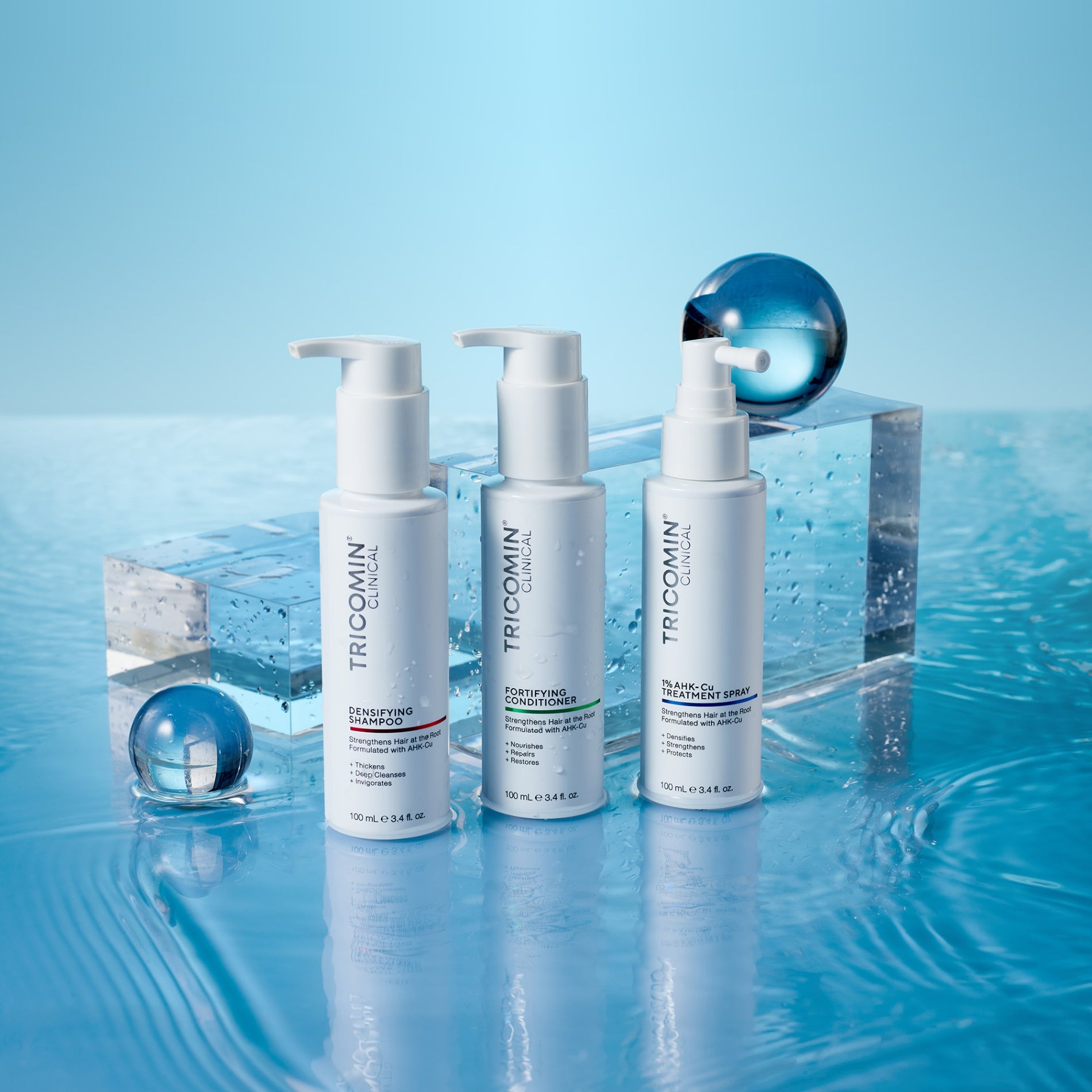
While a daily copper peptide treatment provides focused support, the Tricomin Clinical System takes a comprehensive approach by incorporating AHK-Cu throughout the routine.
It was designed as a complete copper peptide scalp treatment that delivers AHK-Cu during every stage of the routine: cleansing, conditioning, and targeted leave-in treatment. This multi-step approach helps maintain consistent exposure to copper peptides while supporting the overall scalp environment.
By delivering copper peptides during cleansing, conditioning, and targeted treatment, the system helps provide consistent support for the follicle environment over time.
How the Three-Step System Works
Step 1: Densifying Shampoo opens each wash session by removing the sebum, product residue, and environmental debris that can accumulate at the follicle opening and impede active penetration, while delivering AHK-Cu micronutrients to an already-primed scalp.
A clean, balanced scalp environment is essential for supporting hair follicle health. By helping remove buildup while delivering targeted ingredients, the shampoo step prepares the scalp for the treatments that follow.
Step 2: The Fortifying Conditioner follows at the conditioning step. It contains plant proteins and amino acids that reinforce the hair shaft, reducing breakage and surface-level mechanical stress, while the AHK-Cu complex continues its work at the scalp.
Because visible thinning can be influenced by both follicle changes and weakened strands, supporting the hair fiber itself is an important part of improving the appearance of thicker, fuller-looking hair.
Step 3: The system closes with the 1% AHK-Cu Treatment Spray applied to dry or towel-dried hair and scalp: concentrated, unrinsed, daily AHK-Cu delivery at 1% (the concentration that matches the published research).
This targeted AHK-Cu scalp treatment provides direct, leave-in support where it matters most: the scalp and follicle environment.
For individuals searching for the best copper peptide treatment for hair loss, the Tricomin Clinical approach combines research-backed AHK-Cu technology with a complete daily regimen designed to support stronger strands, improved resilience, and healthier-looking hair over time.
Why a System Outperforms a Single Product
A single leave-in treatment provides targeted support for hair thinning. However, hair health is influenced by multiple factors, including nutrition, scalp condition, strand strength, and follicle environment.
The causes of hair thinning and loss are complex, which is why a comprehensive approach can be beneficial. A routine that supports scalp health, follicle function, and strand strength addresses multiple contributors to the appearance of thinning hair.
The Tricomin Hair Strengthening System addresses each stage of the routine by cleansing the scalp, conditioning the hair fiber, and delivering concentrated AHK-Cu treatment to deliver more consistent results.
Consistent use is key when evaluating any hair loss treatment for thinning hair because the hair growth cycle naturally occurs over several months. Supporting follicles through repeated growth cycles allows changes in hair appearance and strength to develop gradually.
What to Expect: A Realistic Timeline of Results
One of the most important things anyone starting a copper peptide hair care protocol should understand is the biology of the timeline. Hair cycles are measured in months. An anagen phase runs between two and seven years; a telogen phase lasts approximately 100 days.
Because the hair growth cycle is gradual, visible improvements from a copper peptide scalp treatment require consistency and patience. Supporting the follicle environment is a long-term process, not an overnight solution for thinning hair.
Days 30–60: Reduced Shedding
The first observable change for many people is a reduction in daily shed. The scalp environment is improving; follicles that were prematurely entering telogen are being supported to stay in anagen. Improvements in shedding are often noticed within this window with consistent use.
For individuals looking for how to stop hair shedding, maintaining consistency with a targeted hair care routine is essential. A healthy scalp environment, proper cleansing, and follicle-supporting ingredients like AHK-Cu may help support the conditions needed for stronger-looking hair over time.

3 Months: Initial Density Improvements
Short new hairs along the hairline and at the part are often the first visible sign of anagen re-entry. Strand texture may also begin to change. Follicles may produce slightly thicker, more resilient fibers as DPC function is supported.
This stage is when many users begin noticing improvements in the appearance of hair thickness, fullness, and overall hair quality. While individual results vary, consistent copper peptide hair growth support may help improve the look of weakened, thinning areas over time.
6 Months: Meaningful Visible Change
The 3–6 month mark is when most people using Tricomin Clinical consistently describe meaningful improvement in overall density, coverage, and strand strength.
This timeframe aligns with the natural pace of the hair growth cycle and allows follicles time to progress through multiple stages of growth and renewal.
This is the clinical benchmark, and the point at which the follicle environment has had sustained AHK-Cu exposure across at least part of a complete growth cycle.
Ongoing: Maintenance and Compounding
The improvements achieved with consistent copper peptide therapy are maintained through continued use.
For those managing ongoing concerns such as androgenetic alopecia treatment needs, female pattern hair loss, male pattern hair loss, or age-related thinning, long-term scalp support can play an important role in maintaining the appearance of healthier-looking hair.
Unlike short-term approaches focused only on surface-level appearance, the Tricomin Clinical system is designed to support the foundation of hair health: the scalp, follicle environment, and strength of each individual strand.
Note: For individuals with significant or rapidly progressive hair loss, concurrent evaluation by a dermatologist or trichologist is recommended. AHK-Cu-based care works well alongside medical treatments but does not replace clinical diagnosis when an underlying cause needs to be identified and addressed.
Frequently Asked Questions about AHK-Cu for Hair Loss
What is AHK-Cu and how does it work for hair loss?
AHK-Cu is considered a specialized copper peptide for hair loss because it was studied specifically in relation to human hair follicles and dermal papilla cells. By supporting a healthy follicle environment, AHK-Cu provides the scientific foundation behind the Tricomin Clinical approach to supporting thicker, healthier-looking hair.
Research has shown that AHK-Cu helps support key biological processes involved in hair follicle health, including dermal papilla cell activity and signals associated with the natural hair growth cycle[2].
By helping maintain a supportive follicle environment and promoting a longer growth phase, AHK-Cu provides the scientific foundation behind the Tricomin Clinical approach to supporting thicker, healthier-looking hair.
Who is Tricomin Clinical designed for?
The Tricomin Hair Strengthening System is designed for anyone looking to support healthier-looking hair, including individuals concerned with thinning hair, seasonal shedding, reduced strand strength, or changes associated with aging.
The system is well-suited for use alongside medical treatments for androgenetic alopecia, and for managing the effects of telogen effluvium, post-partum shedding, or age-related hair changes.
Because the causes of hair thinning can vary, Tricomin Clinical is designed as a supportive hair care system rather than a replacement for medical diagnosis or prescribed treatments. Its formulas are fragrance-free and developed for sensitive scalp environments, so they are broadly well-tolerated.
Can AHK-Cu be used alongside other hair loss treatments?
Yes. Tricomin Clinical's AHK-Cu formulas, such as the Densifying Shampoo and Fortifying Conditioner, are designed to complement a broader hair health protocol and are generally compatible with minoxidil, prescription treatments, and in-office procedures.
Many individuals incorporate copper peptide scalp treatments as part of a comprehensive routine alongside other approaches recommended by their healthcare provider. Consult a dermatologist or trichologist about specific combinations if you are managing a diagnosed hair loss condition.
The Science Behind Stronger, Healthier-Looking Hair Starts at the Follicle
Hair health is shaped by the environment surrounding the follicle. As research continues to uncover the role of copper peptides in supporting follicle biology, AHK-Cu has emerged as a key technology for maintaining a healthy scalp environment and supporting the natural hair growth cycle.
Tricomin Clinical applies this science through a complete AHK-Cu-powered system designed to support every step of your hair care routine. With consistent use, the system helps promote stronger strands, improved hair resilience, and the appearance of thicker, healthier-looking hair over time.
Sources
[1] Pickart L, Vasquez-Soltero JM, Margolina A. GHK Peptide As A Natural Modulator Of Multiple Cellular Pathways In Skin Regeneration; Biomed Res Int 2015;2015:648108. doi: 10.1155/2015/648108. Epub; 2015 Jul 7.:648108.
[2] Pyo, H.K., Yoo, H.G., Won, C.H. et al. The effect of tripeptide-copper complex on human hair growth in vitro. Arch Pharm Res 30, 834–839 (2007). https://doi.org/10.1007/BF02978833.