
Vitamin C vs Niacinamide: Which Is Better for Your Skin?
Both vitamin C and niacinamide can improve the appearance of uneven tone, support healthier-looking skin, and address visible signs of environmental stress, but they work through different biological pathways and have different formulation considerations.
Vitamin C, particularly L-ascorbic acid, is a potent antioxidant with established roles in collagen synthesis, oxidative defense, and pigmentation pathways. Niacinamide, also called nicotinamide, is a form of vitamin B3 that supports cellular processes involved in skin barrier function, pigmentation, inflammation, and cellular energy metabolism. Clinical research supports benefits for both ingredients, but the evidence and intended uses are not identical [1-5].
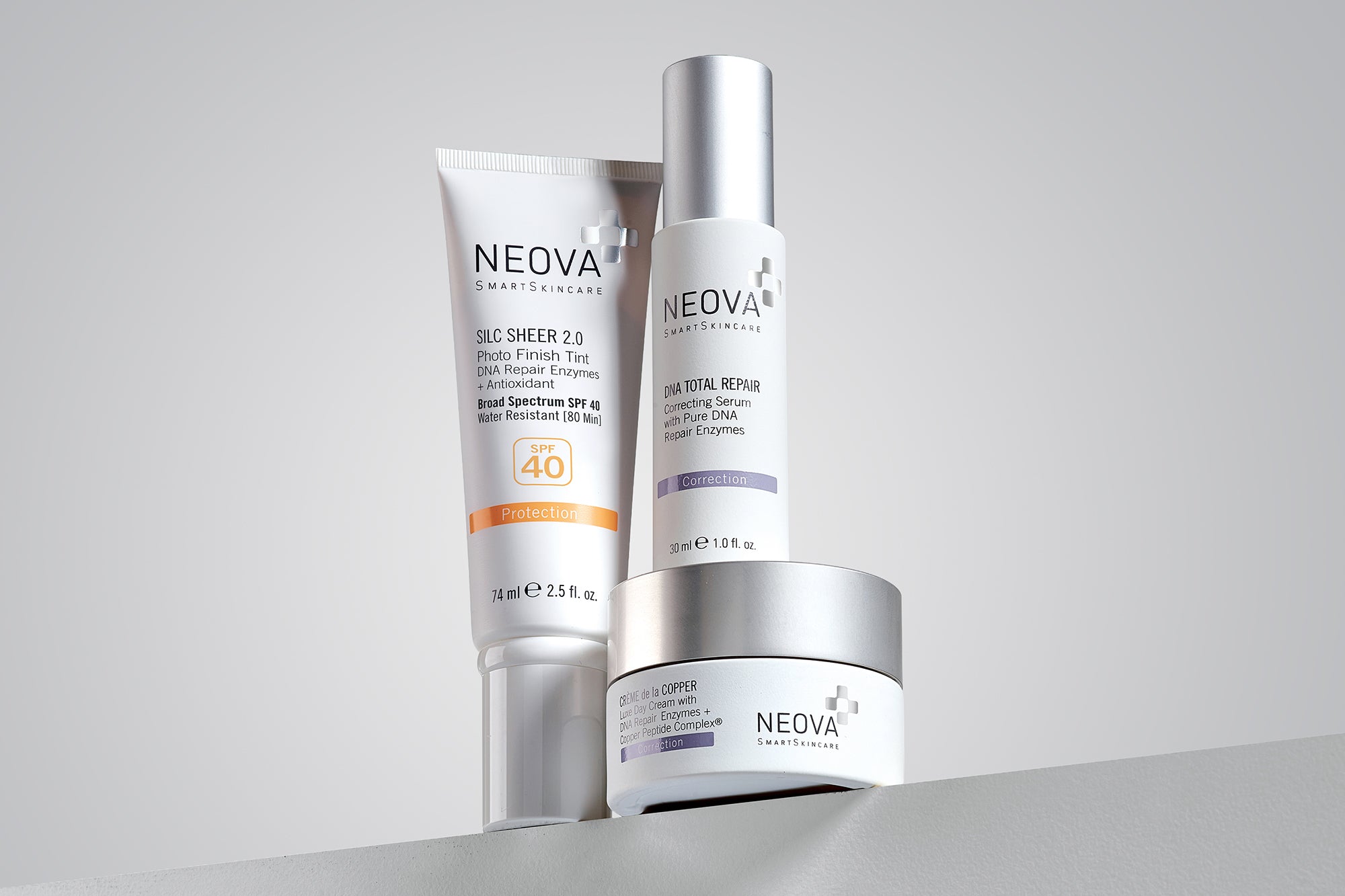
For NEOVA, vitamin C is part of a broader approach to skin health centered on antioxidant defense, environmental protection, and visible correction. Our vitamin C portfolio uses L-ascorbic acid in C 20+ and ascorbyl palmitate in formulas including Serious Clarity 4X, Serious Glypeel, Active SPF 43, and Everyday SPF 44.

Vitamin C and Niacinamide: Different Ingredients, Different Mechanisms
Vitamin C and niacinamide are both associated with brighter, more even-looking skin, but their mechanisms are substantially different.
Topical vitamin C acts primarily as an antioxidant and has several skin-relevant biological functions. L-ascorbic acid can neutralize reactive oxygen species generated by environmental stressors and serves as a cofactor in collagen synthesis. Research also indicates that vitamin C can influence melanin production, which helps explain its use in skincare formulated for uneven pigmentation and photodamage [1,3,5].
Niacinamide works through a different biochemical system. As a form of vitamin B3, it contributes to the production of NAD and NADP, coenzymes involved in cellular energy metabolism and redox reactions. Topically, niacinamide has been studied for its ability to support the epidermal barrier, influence pigmentation, reduce the appearance of uneven tone, and improve several visible signs associated with skin aging [4,6].
One particularly interesting distinction between the two ingredients involves pigmentation. Vitamin C can influence melanin production and has been studied for its ability to improve the appearance of pigmentation. [3,7]. On the other hand, niacinamide has been shown to reduce the transfer of melanosomes from melanocytes to keratinocytes. In a clinical study, topical 5% niacinamide reduced hyperpigmentation after four weeks, supporting the idea that it can affect pigmentation through a pathway distinct from direct inhibition of melanin production [6].
This difference is useful when evaluating a skincare routine. Ingredient names alone do not tell you how a formula is expected to work. The concentration, chemical form, vehicle, pH, stability, and combination of supporting ingredients all influence what ultimately reaches the skin.

Vitamin C Benefits for Skin: Antioxidant Defense, Collagen, and Tone
Vitamin C has one of the more extensive histories of investigation among topical antioxidants, particularly in relation to photoaging and uneven pigmentation. Clinical research has found improvements in photodamaged skin following consistent topical vitamin C use, including changes in skin texture and the appearance of fine lines. A 2023 systematic review of seven clinical studies found evidence that topical vitamin C could improve the appearance of uneven, wrinkled skin and pigmentation, although the authors noted that more research is needed and that longer-term use may be required for noticeable changes [7].
Its antioxidant function is also particularly relevant to environmental exposure. Ultraviolet radiation can generate reactive oxygen species in skin, contributing to oxidative stress and downstream damage. Topical antioxidants such as vitamin C can supplement the skin's antioxidant defenses, making them useful partners to daily sun protection. Vitamin C should not, however, be considered a replacement for broad-spectrum sunscreen [3,5].

Vitamin C also has an important relationship with collagen biology. L-ascorbic acid participates in enzymatic reactions required for collagen maturation, which helps explain why topical vitamin C has been investigated for fine lines, firmness, and photodamaged skin [3].
The form of vitamin C matters considerably, too. L-ascorbic acid is the most extensively studied topical form, but it is also inherently unstable. Research on topical L-ascorbic acid has found that formulation characteristics, including concentration and pH, influence skin penetration, with one absorption study identifying 20% as the concentration associated with maximal absorption under experimental conditions [8].
NEOVA's C 20+ Vitamin C Serum uses 20% L-ascorbic acid alongside 1% vitamin E and 0.5% ferulic acid. The formula is designed around antioxidant performance, with an acidic pH and low water content intended to support vitamin C stability. In an 8-week clinical study, expert dermatologist grading found a 22% increase in luminosity and radiance after four weeks and a 20% improvement in skin tone evenness after eight weeks. By the end of the study, 94.7% of participants showed increased luminosity, 42.1% showed improvement in skin tone, and 31.6% showed significant improvement in the appearance of fine lines and wrinkles.
For a more targeted approach to discoloration, Serious Clarity 4X uses ascorbyl palmitate, a lipid-soluble vitamin C derivative, alongside other brightening ingredients including undecylenoyl phenylalanine, manganese tripeptide-1, and licorice extract. This illustrates an important point often missed in vitamin C comparisons: "vitamin C" is a category of compounds, not a single standardized cosmetic ingredient.

Niacinamide Benefits for Skin: Barrier Support, Tone, and Versatility
Niacinamide has earned its place in skincare largely because it is multifunctional. Topical niacinamide has been associated with improvements in barrier function, pigmentation, skin texture, and the visible signs of aging. A 2024 review of clinical evidence describes its applications across cosmetic and dermatologic formulations, including skin barrier support, hyperpigmentation, acne, and dermatitis [4].
The skin barrier is one area where niacinamide has a particularly well-established rationale. The ingredient has been studied in relation to ceramide and other epidermal lipid processes, which can help support the skin's ability to retain moisture. This makes niacinamide a common choice in formulas designed for dryness, sensitivity, or compromised barrier function.
Its pigmentation pathway is also distinctive. In the previously mentioned clinical research, niacinamide reduced melanosome transfer rather than directly suppressing tyrosinase activity. That mechanism helps explain why niacinamide can contribute to a more even-looking complexion without relying on the same pathway as many traditional pigment-targeting ingredients [6].
Niacinamide has been studied across a range of topical formulations and concentrations, with clinical evidence supporting several cosmetic and dermatologic applications [4]. That versatility is one reason it appears in a range of skincare products from cleansers and moisturizers to concentrated serums.
For those comparing vitamin C and niacinamide, however, versatility should not be confused with equivalence. Niacinamide's strengths tend to center on barrier support, pigmentation, and overall skin function, while vitamin C offers a particularly compelling combination of antioxidant activity, collagen-related biology, and photodamage support.

Vitamin C vs Niacinamide: Which Should You Use?
When comparing skincare with vitamin C vs Niacinamide, the better choice depends on what you want the formula to accomplish and how your skin responds to active ingredients.
For antioxidant defense, visible photoaging, fine lines, and overall radiance, vitamin C is a strong fit. L-ascorbic acid has particularly substantial research behind its topical use, while appropriately formulated vitamin C derivatives can offer alternative approaches to delivery and stability [1-3].
For barrier support, dehydration, uneven tone, and a broadly multifunctional daily active, niacinamide can be useful. Its ability to influence barrier function and pigmentation through multiple pathways makes it a common component of everyday skincare [4,6].
The two ingredients can also appear in the same routine. There is no fundamental reason that vitamin C and niacinamide must be treated as incompatible ingredients. Modern formulations can be designed to deliver both, although the finished product's formulation, concentration, tolerability, and intended use still matter more than the presence of either ingredient alone.
At NEOVA, the focus is on vitamin C formulations that fit into a broader skin health strategy. C 20+ provides a concentrated L-ascorbic acid approach for antioxidant defense and visible tone concerns. Serious Clarity 4X and Serious Glypeel use ascorbyl palmitate as part of a multi-active brightening formula. Vitamin C is also incorporated into select NEOVA sun-protection formulas, such as Active (SPF 43) and Everyday (SPF 44), where antioxidant support complements, rather than replaces, broad-spectrum UV protection.

Frequently Asked Questions About Vitamin C vs Niacinamide
1. Is vitamin C or niacinamide better for dark spots?
Both ingredients can help improve the appearance of uneven pigmentation, but they work through different mechanisms. Vitamin C can influence melanin production and provides antioxidant activity, while niacinamide has clinical evidence for reducing melanosome transfer and improving hyperpigmentation. Consistent sunscreen use is also important when treating visible discoloration [3,6,7].
2. Can you use vitamin C and niacinamide together?
Yes. Vitamin C and niacinamide can be used together when the formulas are appropriately formulated and tolerated by the skin. They address different biological pathways, so using both can be part of a comprehensive skincare routine.
3. Is niacinamide a form of vitamin C?
No. Niacinamide is a form of vitamin B3, also known as nicotinamide. Vitamin C refers primarily to ascorbic acid and related derivatives, like ascorbyl palmitate, used in topical skincare. They are chemically and biologically distinct ingredients [4,5].
4. What form of vitamin C is best for skin?
L-ascorbic acid is among the most extensively studied topical forms of vitamin C, particularly for photodamage, pigmentation, and visible skin aging. It is also less stable than many derivatives, so the finished formulation is critical. Vitamin C derivatives such as ascorbyl palmitate provide alternative formulation approaches, but evidence varies by derivative and product [1,2,9].
5. Can vitamin C replace sunscreen?
No. Vitamin C provides antioxidant support against environmental oxidative stress, but it does not replace the broad-spectrum UV protection provided by sunscreen. Use vitamin C as part of a daily routine that includes broad-spectrum sun protection [3,5]. For added antioxidant support, NEOVA’s Everyday (SPF 44) and Active (SPF 43) sunscreens feature vitamin C in its ascorbyl palmitate form alongside DNA repair enzymes.

Vitamin C vs. Niacinamide: The Takeaway
Vitamin C and niacinamide can both have a place in evidence-informed skincare, but the right choice depends on the biological pathway, formulation, and skin concern you are trying to address.
For a concentrated L-ascorbic acid treatment, explore C 20+. For targeted discoloration support using a vitamin C derivative alongside complementary brightening technologies, explore Serious Clarity 4X or Serious Glypeel. Complete your daytime routine with Active SPF 43 or Everyday SPF 44 for daily UV protection.
Find Your Formula: Shop Vitamin C Skincare.
Sources
- Vasques LI, Vendruscolo CW, Leonardi GR. Topical Application of Ascorbic Acid and its Derivatives: A Review Considering Clinical Trials. Curr Med Chem. 2023;30(29):3272-3286. doi: 10.2174/0929867329666221003102238. PMID: 36200216.
- Hořavová H, Brückner K. Topical application of vitamin C and its derivatives in dermatology and cosmetics. Ceska Slov Farm. 2025;74(4):272-275. English. doi: 10.36290/csf.2025.044. PMID: 41412811.
- Al-Niaimi F, Chiang NYZ. Topical Vitamin C and the Skin: Mechanisms of Action and Clinical Applications. J Clin Aesthet Dermatol. 2017 Jul;10(7):14-17. Epub 2017 Jul 1. PMID: 29104718; PMCID: PMC5605218.
- Ong RR, Goh CF. Niacinamide: a review on dermal delivery strategies and clinical evidence. Drug Deliv Transl Res. 2024 Dec;14(12):3512-3548. doi: 10.1007/s13346-024-01593-y. Epub 2024 May 9. PMID: 38722460.
- Telang PS. Vitamin C in dermatology. Indian Dermatol Online J. 2013 Apr;4(2):143-6. doi: 10.4103/2229-5178.110593. PMID: 23741676; PMCID: PMC3673383.
- Hakozaki T, Minwalla L, Zhuang J, Chhoa M, Matsubara A, Miyamoto K, Greatens A, Hillebrand GG, Bissett DL, Boissy RE. The effect of niacinamide on reducing cutaneous pigmentation and suppression of melanosome transfer. Br J Dermatol. 2002 Jul;147(1):20-31. doi: 10.1046/j.1365-2133.2002.04834.x. PMID: 12100180.
- Correia G, Magina S. Efficacy of topical vitamin C in melasma and photoaging: A systematic review. J Cosmet Dermatol. 2023 Jul;22(7):1938-1945. doi: 10.1111/jocd.15748. Epub 2023 May 2. PMID: 37128827.
- Pinnell SR, Yang H, Omar M, Monteiro-Riviere N, DeBuys HV, Walker LC, Wang Y, Levine M. Topical L-ascorbic acid: percutaneous absorption studies. Dermatol Surg. 2001 Feb;27(2):137-42. doi: 10.1046/j.1524-4725.2001.00264.x. PMID: 11207686.
- Enescu CD, Bedford LM, Potts G, Fahs F. A review of topical vitamin C derivatives and their efficacy. J Cosmet Dermatol. 2022 Jun;21(6):2349-2359. doi: 10.1111/jocd.14465. Epub 2021 Sep 24. PMID: 34559950.